Thursday, March 31, 2016
When I'm not sure how to address kids I come across
Because sometimes it's hard to distinguish between genders!

Friday, March 11, 2016
15 January 2016: Meetup with the duQlings
Earlier this week, I
escaped my village to meet up with Hanna and Melinda, the new PCVs in Quthing
district, whom I refer to fondly as the duQlings. After a few days in Quthing
town, I can see myself not having to be dependent on Mohale’s Hoek for pizza,
friends, and wifi. In the morning, I took the taxi all the way up to Upper
Moyeni where my first stop was the bank. I signed up for text alerts for my
bank account [update: this never happened] and asked to get a PIN for online
banking. They took my phone number and passport scan and said they’d get back
to me when their machine that prints PINs is working again [update: this never
happened either]. My next stop was the post office where I bought stamps for
postcards. My third stop was at the Orange River Lodge to inquire about pizzas.
Confirmed: the rumors are true- they do make pizzas there. Then I traipsed down
the switchback road to drop my stuff at the hotel in Lower Moyeni where our relatively
new VRC (volunteer resource center) is. I settled into a small couch, logged on
to the wifi, and tinkered around with my 2 grants on PC’s grant website.
Then Hanna, and shortly Melinda, showed
up, joining me on the couches for some good old fashioned human (maybe “American
human” is a better description) contact, which they admitted was lacking in
their villages. Ahhh I remembered first moving to site a year ago and how
awfully boring it all was.
We soon 4+1ed it to
the Orange River Lodge to get some long-awaited pizzas. We were met by an
unusually stylish and energetic guy at the front desk with flawless English,
who was quite excited to chat with us. There was some kind of agriculture conference
at the hotel, so it was packed with people. Without fail, as we sat in the
lobby waiting for our pizzas to be ready, every person who passed by at least
said hi to us. In the US, would you go out of your way to have a conversation
with three random strangers? Nope. But in Lesotho, when you see three white
girls sitting there, apparently you do just that. After a long wait, we finally
got our glorious pizzas, packed with more cheese and meat than I’d seen in
quite a long time. After we ate, super stuffed, we headed back down to Lower
Moyeni and did some grocery shopping, then got into Hanna’s taxi to her
village, about 45 minutes from town. Her taxi driver was super cool, and we
asked him where to find “Quthing, my natural habitat” shirts that we had seen
several people wearing around town. On his way down the main road, he pulled
off next to a tin shack, yelled some stuff out the window, then turned back to
us saying that they’d have the shirts for us tomorrow. Ask and you shall
receive!
On the way to Hanna’s,
there was a drunk old man who was saying ridiculous things. At one point, when
the sliding door wouldn’t open, he said (in English), very matter of factly, “we
are going to die.” No we won’t, I thought. This van is packed with at least 12
bottles of soda and several huge, 300-count bags of what looked like old, stale
biscuits. If we couldn’t climb out the sunroof, we could survive off this food for
at least a few days before having to cannibalize other passengers. We arrived
at Hanna’s house and we ate our leftover pizza as Melinda told us about her
year living in New Zealand and her multiple trips to Nepal and Mount Everest
base camp with her wilderness-rescue uncle. Hanna, it turns out, has lived in Sweden
almost her whole life (with one American parent and one Swedish parent), which
was also very interesting to hear about. Hanna’s puppy Leli (short for
lelinyane, which means any kind of baby animal) was super cute, tiny, hyper,
and spoiled. We had fun playing with her as she squirmed around. The next
morning, Melinda and I headed back to town. After getting some soft serve and hot
makoenyas (fried bread balls), we taxied to Mount Moorosi. There, we parted
ways as she got on a taxi to her village and I got on a taxi to mine.
Even though there is
a grand whopping total of 3 PCVs in the entire district (compare this with
Mohale’s Hoek, which has at least 13), I think it’s a great little group. Here’s
hoping for more fun meet-ups to come!
9 January 2016: Unexpected Moments / Dog Update
It’s
often the chance encounters in the day that make them worthwhile. In the past 2
days, I’ve had 3 such moments.
1)
I was walking back
from the shop when I saw an oldish man on a horse next to a man and a woman
spreading something out on grain sacs to, I assume, dry in the sun. I decided
to wander over, mostly to see what was drying. In Sesotho: “You want some
sorghum?” the woman asked. “No, I’m just looking,” I replied. I looked up at
the man on the horse, “Lumela, ntate” (Hello, father). He greeted me back,
repeating, “Lumela, ntate.” Ignoring the fact that I was again called a man
(but at the same time wondering why people are STILL mistaking me- it’s not
that hard, people), I continued to talk to the sorghum-spreading ‘me. The sorghum-spreading man interrupted
and corrected the horse man, “No, this is ausi (sister) Senate,” and proceeded
to tell him all about me- I live in the village across the valley, I teach at
the secondary school, etc. It made me proud that this dude is so eager to
defend my identity and this just proves how integrated I’ve become here.
2 2) I walked up the
water tap hill to sit under its luscious tree to read a French book about a
herd boy that my friend Jen got from the Morija museum. Then, this woman I’ve
never met came up to me, greeted me, and was surprised that I knew Sesotho (as
is always the case with people I’m just meeting). Turns out, she’s related to
my host family, lives in SA, and is just visiting her family and her childhood
home. She took a photo of me, her newly-found relative, hugged me (strange for
a Mosotho- they’re not usually huggers), and after we exchanged complaints
about the insane heat, she went about her way. Never even met me, but once she
knew I was “related,” she immediately treated me as such.
3 3) Today my oldest ausi
Palesa was taking a day off from her summer job of cutting wood for some reason
or another, and I taught her how to play 2 card games- war and speed. She
actually beat me at speed a few times after she got the hang of it. Then she
came back after cooking papa and asked for my tennis ball. She showed me how to
play this game called “chicha” where you bounce the tennis ball under and
between your legs while chanting this song. Even my ‘me joined in to play. Even
though I really didn’t know what I was doing, it was really fun, and there were
laughs all around as time after time I messed up the sequence of bounces or
didn’t catch the ball after a bounce. Eventually I was just embracing the fact
that I was hopeless at it and just improvised the whole thing. She says I
should practice more. Yes ma’am.
Dog update: The Bo
Bo got so big that I had to cut the dog house door bigger so that it didn’t
have to crouch down so far to get inside. It even walked with me to the shop
yesterday without a leash. I think it can get around the village on its own
now, so I don’t have to bother keeping it within a 3 foot radius from me with a
leash. Though it does like to follow me everywhere- even trying to come into
the latrine with me. Nope, sorry dog. You can pee wherever you want. This is my
own space. Then it started playing fetch (sort of) with an old animal jaw bone
yesterday, and was even chasing the tennis ball when Palesa or I let it bounce
away. What started as a low-maintenance dog has become an even
lower-maintenance dog and even likes to play dog games. Woo! And PC would be
proud, as I am creating a non-spoiled, “sustainable” pet. They love that word,
sustainable. As a true Basotho dog, my dog eats papa, eggs, and leftovers.
Because I don’t plan to take it back with me after I’m done here, I think its
transition to either a new volunteer or to my host family will be quite smooth.
Wednesday, March 9, 2016
*New mailing address*
Don't send stuff to the PC office anymore. Please send it to:
Julie Fisher
Quthing Secondary School
PO Box 254
Mount Moorosi 750
Lesotho
Southern Africa (optional)
If you're feeling inspired, just know I still love letters! Send me one and I'll send you a cool postcard from Madagascar!
Wednesday, March 2, 2016
To keep y'all occupied
while I work on some recent posts and an important announcement, here's a photo of a space invader and my Texas flag. After all, it is Texas Independence Day. Is it appropriate to go outside and yell "REMEMBER THE ALAMOOOO!" ?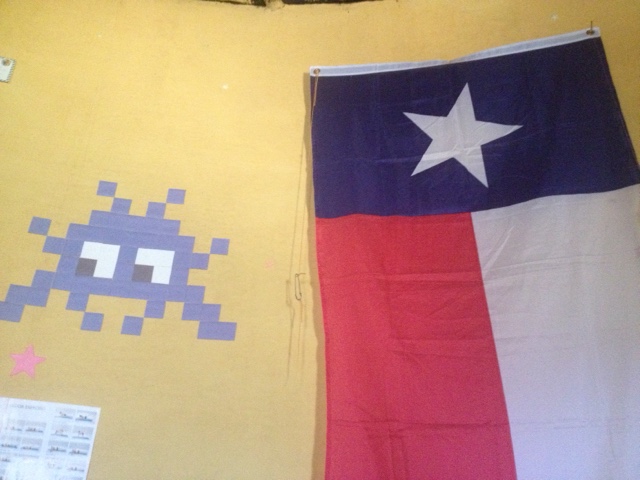
Sunday, February 21, 2016
Lesotho Happiness
https://m.youtube.com/watch?v=mptgYzK-n4w
A video made by fellow PCVs that highlights the power of song and dance to bring happiness!
Friday, February 19, 2016
The crisis of Lesotho's "Green Drought"
Text copied from theguardian.com
For 14-year-old Hopolang Staka, Lesotho’s worst drought in more than four decades means fewer meals, a daily two-hour trek for water and an education postponed.
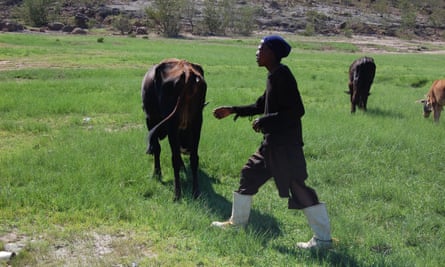
At the family’s small holding in Mafeteng, 70km south of the capital Maseru, Hopolang, an Aids orphan, supplements the 350 maloti (£15) monthly child support grant from the government with income from herding neighbours’ cattle. He dropped out of school last year because his street hawking brothers couldn’t afford the fees.
A second year of inadequate rains has dried up water sources across the small mountain kingdom, killed livestock and may leave as many as one in three Basotho requiring food aid until next year, according to local UN officials. Lesotho officials say a recent downpour greened Lesotho’s valleys, camouflaging a crisis that’s increasing malnutrition and disease.
“It’s what they call the ‘green drought’,” says Phole Mpobole, assistant administrative officer of Ha Raliemere district in Mafeteng. “The green grass is deceptive, the water table is down. There is nothing in those fields, not even vegetables.”
Three UN agencies – Unicef, the World Food Programme and the Office for the Coordination of Humanitarian Affairs – are responding to the El Niño-induced drought which has also scorched South Africa, Zimbabwe and Malawi, forcing them to declare food emergencies.
Lesotho’s prime minister, Pakalitha Mosisili, last week appealed for $28m (£19.5m) to help feed people, provide water and protect livestock in a country where 80% of the population relies on farming. His government has already set aside $10m. Haretsebe Mahosi, the Disaster Management Authority (DMA) chief executive, says the disease burden is rising along with hunger, estimating 650,000 people need food aid now, with the number expected to rise.
“We don’t have to wait for people to die,” says Tesfaye Shiferaw, the Unicef representative in Lesotho. “We are working under a declared emergency. It is the duty for all of us to respond.” Unicef is appealing for $3m to augment supplies including nutritional supplements for children and water purification tablets.
A Lesotho government drought assessment shows up to 56% of communities are using unprotected water sources; all 10 districts reported disease outbreaks, an increase in gender and sexual violence, a drop in the national herd and increasing food prices because of scarcity and demand.
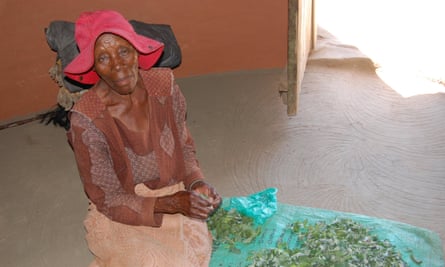
On a hill a few kilometres east of Hopolang’s home, 74-year-old Marentseng Tjamela says she hasn’t seen a worse drought in her life. On her 550 maloti pension, Tjamela is struggling to feed five orphan grandchildren. She begs and borrows from neighbours after failing to get state child support because of inadequate documents. When four of her five cattle died from a lack of water and disease, she ate them with neighbours.
“Lebitla la khomo ke molomo (the grave of a cow is the mouth),” she says. “There is nothing to give my grandchildren,” she says through an interpreter, adding that on most days they survive on one meal.
The drought will stretch government resources at a time when state revenues have been hit (pdf) by lower commodity prices, reduced earnings from the Southern African Customs Union and declining remittances from South Africa-based workers.
South Africa, which surrounds Lesotho, is itself in danger of slipping into a recession as companies and farmers are retrenching thousands of workers, including Basotho. Unicef says Lesotho already spends the equivalent of 9% of its GDP on social services, one of the highest rates in the world.
In the countryside, social workers say conflict and malnutrition are on the rise, with many people surviving on two meals a day, consisting of porridge and the traditional pap meal of thickened maize meal and vegetables. For many children, their only proper meal is at school, where the WFP is feeding 250,000 children countrywide.
Mary Njoroge, the WFP’s country director, says people are adopting negative coping mechanisms such as eating less, reducing the number of meals per day, buying food on credit, eating one type of food, selling assets, eating seed crop and theft.
“I have never seen anything like it,” says Mabvisa Mabusa, a sub-chief in Mafeteng. “There is a lot of crime; men against men, village against village. People are stealing even during the day. There is a lot of uneasiness in the community.”
At Mafeteng hospital, Matsola Ntlale, the hospital manager, says malnutrition cases are increasing. This year, she has also seen more than 100 anthrax cases. Officials says anthrax cases are on the rise because poor grazing fields are causing cattle to feed on the soil, which sometimes has the disease.
“We haven’t seen any direct deaths from the drought yet but malnutrition cases are rising,” she says. “We have also had some HIV and Aids patients who have stopped taking their medicines saying the drugs make them sick when they don’t eat properly.”
Because of water shortages, large parts of the country are now solely reliant on water trucks, the DMA’s Mahosi said. Most of the money the government is seeking will be used to buy water tankers, medicine, food and other logistics.
He says the government is warily watching accelerating food prices because of the 26% drop in the value of the rand against the major foreign currencies in the past year. Lesotho imports most of its food from South Africa.
“The situation is very tight and we are expecting it to get worse,” Mahosi said. “We want the donors to respond yesterday.”
• Godfrey Mutizwa travelled with Unicef
Saturday, February 13, 2016
Thursday, February 11, 2016
"Hey Form Cs, wanna play with my hair?"
They certainly delivered. There are more braids on the other side too.

No shortage of entertainment with the Form Cs. Now excuse me for the next hour as I attempt to unbraid this hilarity.
I showed the other math teacher and he was like, "Wow. Those kids are crazy."
Subscribe to:
Posts (Atom)